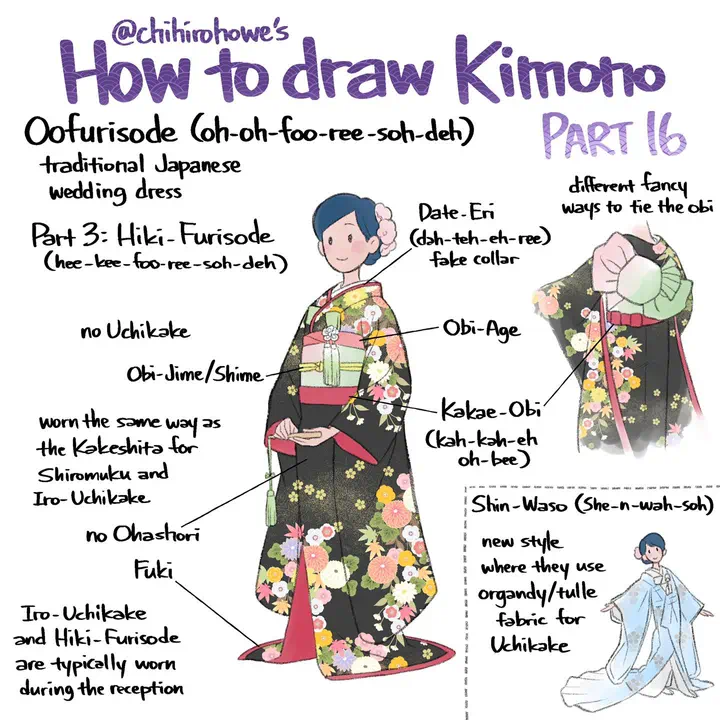
A type of traditional Japanese clothing, consisting of a long, wide-sleeved robe, closed at the front forming a "y" shape. It is held closed with a wide belt-like sash called an obi. The sleeves can be tied back with tasuki.
Kimonos are often worn with other traditional accessories, such as zouri (traditional wooden sandals), tabi (split-toe socks), and kanzashi (traditional hair ornaments). A kinchaku (small cloth drawstring bag) is often carried while wearing a kimono.
Juban are usually worn under the kimono as the inner layer, and used by some as sleepwear.
Of note, Kimono from the Sengoku Jidai onward are generally single-piece or layered robes tied with an obi. The Nibushiki Kimono, developed around the 1970s, is a more modern development with incorporates an obi with a two-piece shirt and dress and not considered traditional. If you are tagging a two-piece set of attire with a sash where the bottom-piece is not a hakama consider using hanbok or hanfu instead.

 Pixiv
Pixiv
 Twitter
 Bluesky
 Weibo
Weibo
 Lofter
 Tumblr